|
 Home | Webstore Home | Webstore
|
|
Latest News:
OOTP 25 Available
- FHM 10 Available
- OOTP Go! Available
Out of the Park Baseball 25 Buy Now! |

|
|
||||
| ||||
|
|||||||
| OOTP Dynasty Reports Tell us about the OOTP dynasties you have built! |
 |
|
|
Thread Tools |
 06-16-2006, 05:28 PM
|
#1 |
|
Minors (Double A)
Join Date: May 2003
Location: South Florida
Posts: 119
|
Sports & History Dynasty
I love sports and I love history, and I really love some of the historical dynasties I've seen here, so I thought I would try one of my own. This dynasty will feature both sports and history. I'll start it in 1857. Recreational sports in America had existed before then. But in 1857, several top New York and Brooklyn amatuer base ball teams (yes, it used to be two words) convened and organized a uniform set of rules to use for their matches. This launched us on the road to modern sports as we know them today.
Besides, it was also an interesting time in history as well, as our nation was fast approaching Civil War. I've decided to document this dynasty in two monthly journals. During this time, journals (i.e. magazines) became increasingly popular with readers. The Sport will obviously cover the happenings in the sport part of the dynasty while The Monthly Republic will cover the historical aspects. To make it more interesting, I will use a modern approach to the news instead of trying to emulate the writing style of the period. I will use a variety of sims to simulate these early years of sport as well as I can. I may also make portions of the dynasty interactive as I move along to pursue "what if" scenarios. Who knows, if the muse so moves, I may change history as we move along as well.
__________________
GM, Miami Sharks, IHOF Founder & President, SFL GM, Oklahoma Outlaws, GEFL Read my "Sports and History Dynasty" |

|

|
|
06-16-2006, 05:29 PM
|
#2 |
|
Minors (Double A)
Join Date: May 2003
Location: South Florida
Posts: 119
|
THE SPORT (JANUARY, 1857)
WORLD BOXING British heavyweight champ untested In England William Perry, called the "Tipton Slasher," lays claim to the English heavyweight championship. However, many dispute or say his claim is nebulous at best, pointing out that he hasn't fought an actual bout since '51. Perry originally took the title in 1850, during a championship bout with Tom Paddock. The fight was stopped after Paddock fouled Perry by striking him on the neck as he walked to his corner, giving the "Slasher" the title. Apparently, retired champion William Thompson (19-1) was unimpressed with Perry and gave no reply when Perry formally requested the Championship Belt from him following the Paddock fight. In '51, Perry lost the championship briefly to Harry Broome. Perry struck Broome while he was kneeling and was disqualified. The two were scheduled to fight again in August of '53, but Broome forfeited, returning the title to Perry. The "Slasher" scheduled two matches last year, one against Aaron Jones and a much anticipated rematch against Tom Paddock in October. Neither bout was held as both Jones and Paddock forfeited. Perry has promised a bout against a top contender this year. THE CURRENT CHAMP William Perry "The Tipton Slasher" Age: 37 Height: 6-0 1/2 Weight: 185-189 Record: 6-2, 4 Draws The Scoop: He possesses average physical skills but is tricky, cool under pressure and uses good judgement. TOP ENGLISH CONTENDERS Tom Sayers "The Brighton Boy" Age: 30 Height: 5-8 1/2 Weight: 112-154 Record: 8-1, 3 Draws The Scoop: A great fighter. Often fights much larger men. A skillful pugilist who throws stiff punches, is tough, and always is ready to take the fight to an opponent. Tom Paddock Age: 32 Height: 5-10 1/2 Weight: 166-168 Record: 11-3 The Scoop: A skillful, strong and durable fighter. Easily frustrated. Known to resort to violent foul tactics in the ring. Harry Broome Age: 31 Height: 5-10 1/2 Weight: 147-178 Record: 5-1, 2 Draws The Scoop: One time Welterweight champ. Exceptionally strong and tough. A better wrestler than pugilist. Said to be leaning toward retiring from the ring. A title bout could change his mind. UP-AND-COMING "Gypsy" Jem Mace Age: 25 Height: 5-9 1/2 Weight: 136 Record: 10-2 The Scoop: Very scientific fighter. Top contender in Welterweight division. Many say he could easily make the transition to Heavyweight. "Old Smoke" Morrissey, undeserving American champ John Morrissey represents all that is currently wrong with the sport of boxing. In some ways, his story is the classic 'kid from the wrong side of the tracks making good.' But the dark side to the story is that he has maintained close ties to a lot of people from that other side. This plus the fact that Morrissey is heavily invested in gambling interests presents a major problem for the integrity of sport he represents. Morrisey was a poor Irish immigrant who grew up in Troy, New York. He went to school for a year before becoming a manual laborer. He joined and became the head of a gang of young toughs and during this time Morrissey had frequent run-ins with the police. After Morrissey took a bartending job in Troy, his boss tried to arrange a boxing match between Morrissey and “Dutch” Charlie Duane. When the young fighter went to New York City to challenge Duane at a Tammany Hall hangout, he was badly beaten by the unfriendly crowd. Morrissey stayed in the city, however, as a hired bully, enforcing the political loyalty of recent immigrants. Morrissey was dubbed “Old Smoke,” when he and another “immigrant runner” knocked over a coal stove in a saloon fight and Morrissey was pinned to the burning embers before going on to win. In 1851, Morrissey made his way to California as a stowaway in search of gold. His first organized prize fight took place in 1852 when he challenged Englishman George Thompson, then the California champion. Thompson had the upper hand, but when Morrissey’s supporters brandished weapons, he fouled Morrissey in the twelfth round to forfeit the match. Morrissey then returned to New York to challenge veteran fighter Yankee Sullivan (12-2-0). The fight was held at Boston Corners where New York, Connecticut, and Massachusetts meet, to stymie state authorities who might try to halt the match. Sullivan was 41, and Morrissey just 22, but for 37 rounds, the quicker and more scientific Sullivan thrashed Morrissey, who displayed his great ability to absorb a beating. Then onlookers stormed the ring. When the fighters were called to come to scratch for the 38th round, Sullivan was fending off Morrissey’s second, Orville (“Awful”) Gardner. The referee gave Morrissey the fight, in violation of the rule stating a fight must be stopped until the ring is clear. Morrissey has parlayed this “win” into starting a bar and a gambling house. It is also rumored that he used his connections to avoid convictions for shooting two waiters, three separate charges of assault with intent to kill, and possible involvement in the murder of a political foe. Boxing has been good to "Old Smoke" Morrissey, but he has definitely not been good for the sport. THE CHAMP "Old Smoke" John Morrissey Age: 25 Height: 5-11 3/4 Weight: 170-176 Record: 3-1 The Scoop: Strong, tough and game, but possesses little boxing science. TOP AMERICAN CONTENDER John C. Heenan Age: 21 Height: 6-2 Weight: 182-195 Record: Undefeated on the local scene The Scoop: A fighter to watch. Big, strong, a tough puncher. BASE BALL New York clubs meet Representatives of New York's and Brooklyn's most storied base ball clubs convened on January 22. New Hampshire native Daniel Adams, a New York City physician, and president of the Knickerbocker club served as head of the first convention of baseball players. During the meeting, virtually all of the Knickerbocker regulations were formerly adopted, but the method of deciding the outcome of matches was changed, switching from awarding victory to the first team to score twenty-one runs to awarding it to that team which scored the highest number after nine full innings. Several teams also scheduled matches for this year. The participating clubs included the following from New York: Knickerbockers; Gothams; Eagles; and Empire. Also present were the following Brooklyn nines: Continental; Eckford; Excelsior; Olympics, Bedfords, Harmony and Putnams. Union of Morrisania and Adriatic of Newark were also in attendance. The New York version of the game is fast spreading in popularity, but still competes for public interest with cricket and other regional variants of base ball, notably town ball played in Philadelphia and the Massachusetts Game played in New England. ------------------------------------------------------------ THE MONTHLY REPUBLIC (JANUARY, 1857) US NEWS & POLITICS Blitzed by a big one Blizzard wreaks havoc on Eastern Cities The Eastern Seaboard got rocked by a powerful blizzard between January 16-19 that left behind more than a foot of snow in several major East Coast cities and temperatures hovering in the single digits to near zero. Through mid-January, the '56-'57 winter season had been noted for its lack of snow even though the cold had been unusually brutal and sustained. In the days preceding the storm, a frigid air mass covered much of the eastern half of the country. Temperatures on January 16th ranged from 0 degrees in Boston, to -10 degrees in Hartford, and -18 degrees in East Hartford. During the seventeen hour storm, winds blew at gale-force or above. Cities as far south as Norfolk, Virginia were buried under huge snowdrifts. Controversial Brooks dies Death of Congressman ignites partisan rhetoric 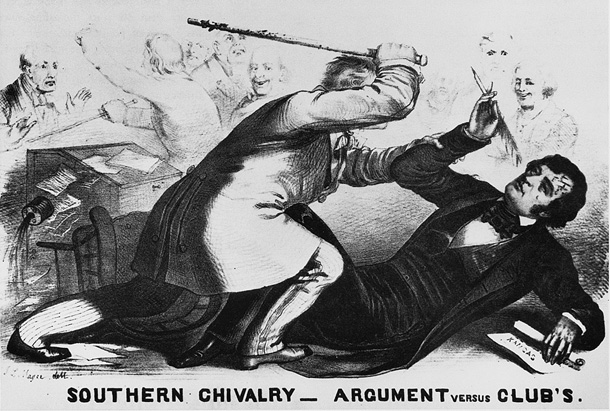 Representative Preston Brooks (D-SC) died Tuesday, January 27, in Washington of complications from the croup. He was 38. Brooks likely will be best remembered for the incident on the Senate floor involving Senator Charles Sumner (R-MA). On May 22, of last year, Brooks approached Sumner who was seated at his desk in the Senate chamber during a recess and began to beat him with his walking cane because of the speech Sumner had made three days earlier which criticized President Franklin Pierce and Southerners who sympathized with the pro-slavery violence in Kansas. In particular, Sumner lambasted Brooks' kinsman, Senator Andrew Butler, who was not in attendance when the speech was read, describing slavery as a whore, comparing Butler with Don Quixote for embracing it, and mocking Butler for his physical handicap, a slight speech impediment due to a stroke. Brooks hit Sumner repeatedly and continued to beat Sumner until his cane broke. Sumner has yet to fully recover from the attack, and suffers from frequent headaches. After news of the incident spread, many of Brooks' South Carolina constituents sent him dozens of brand new canes to replace the one he had broken. The Richmond (VA) Enquirer crowed: "We consider the act good in conception, better in execution, and best of all in consequences. These vulgar abolitionists in the Senate must be lashed into submission." Brooks survived an expulsion vote in the House but resigned his seat, claiming both that he "meant no disrespect to the Senate of the United States" by attacking Sumner and that he did not intend to kill him, for he would have used a different weapon if he had. His constituents thought of him as a hero and returned him to Congress. Even in death, Brooks remains a potent symbol of the increasing vitriol between the North and the South. His passing has ignited a storm of incendiary rhetoric from those on opposing sides of the slavery issue. The newspapers in the North have been almost universal in their condemnation of "Bully Brooks" and took the opportunity to again criticize Southern Congressmen that voted against his expulsion. In particular, Charles Francis Adams said he was appalled by the attempts to "canonize an assassin." In the South, Brooks will continue to be something of a hero. John H. Savage of Tennessee compared Brooks' caning of Sumner to Brutus' slaying of Caesar. Brooks, the member of a prominent Southern family, was born in Edgefield District, SC., August 5, 1819; attended the common schools and was graduated from South Carolina College at Columbia in 1839, where he studied law. He was admitted to the bar in 1845 and commenced practice in Edgefield, SC. He was a member of the State house of representatives in 1844; served in the Mexican War as captain in the Palmetto Regiment of South Carolina Volunteers; elected as a Democrat to the Thirty-third Congress and Thirty-fourth Congress. He served from March 4, 1853, until July 15, 1856, when he resigned even though the attempt to expel him for his assault upon Charles Sumner failed through lack of the necessary two-thirds vote. He was reelected to the Thirty-fourth Congress to fill the vacancy caused by his own resignation and began his term August 1, 1856. Brooks once fought a duel with Texas politician Louis Wigfall and was shot in the hip. This had forced him to use a cane to assist his walking. SCIENCE Icy doom looms Scientists warn of industry spawned age of ice At a recent scientific conference in Washington, several leading scientists interested in climatology warned that freezing temperatures and blizzards like this January's storm could become year-round occurrences, devastating crops worldwide and leading to mass starvation. Many scientists, who have applauded Swedish naturalist Louis Agassiz's theory of an early planetary ice age, say Earth could be heading into another such period of global cold. They point to this century's rash of severe winters as evidence. And while Agassiz's ice age was the product of natural processes, many blame the by-products of modern industrialization for the current threat, saying chemical gases and other pollutants from industry which are released into the atmosphere act as a shield that blocks out the warming radiation from the sun. Many of these scientists say that unless industrialization is curbed, years like 1816 could become commonplace. Often called, "the year without a summer," snowfalls and frost occurred in June, July and August of 1816 and all but the hardiest crops were destroyed. New England and Europe were hit exceptionally hard. Destruction of the corn crop forced many farmers to slaughter their animals for food. Hunger was wide-spread and numerous soup kitchens were opened to battle the problem. Sea ice migrated across Atlantic shipping lanes, and alpine glaciers advanced down mountain slopes to exceptionally low elevations. A popular expression was: "1816 and froze to death!" The scientists say they hope to organize and present a formal appeal for more research into global cooling to the incoming administration of president-elect James Buchanan. Unless something is done, they predict Washington could very well be buried beneath a sheet of glaciers within the next twenty years.
__________________
GM, Miami Sharks, IHOF Founder & President, SFL GM, Oklahoma Outlaws, GEFL Read my "Sports and History Dynasty" Last edited by sflcat; 01-17-2007 at 02:19 PM. |
|
|
|
|
06-16-2006, 09:15 PM
|
#4 |
|
Minors (Double A)
Join Date: May 2003
Location: South Florida
Posts: 119
|
thanks, Metsgeek. You're PLAGUE dynasty is one I follow regularly here and one of the inspirations for me starting my own historical dynasty.
__________________
GM, Miami Sharks, IHOF Founder & President, SFL GM, Oklahoma Outlaws, GEFL Read my "Sports and History Dynasty" |
|
|
|
|
06-17-2006, 10:12 AM
|
#5 |
|
Minors (Double A)
Join Date: May 2003
Location: South Florida
Posts: 119
|
THE SPORT (FEBRUARY, 1857)
BASE BALL Boston's Olympic base ball club publishes rules In response to last month's convention of prominent New York and Brooklyn base ball clubs, Boston's oldest base ball club, the Olympics, published rules and regulations for the Massassachusetts Game. The move is seen as Bean Town's attempt to slow the growth of the New York version of base ball - which uses the Knickerbocker rules - and promote its own brand of the game. Sometimes called town ball, the Massachusetts Game differs from the New York game in the following ways: It features a square instead of a diamond for the bases, with the batter standing in an area halfway between home and first. While the New York regulations stipulate that the ball has to be pitched underhand, and that a ball knocked outside the range of first or third base is foul, the ball is thrown overhand to the striker in the Massachusetts game and there is no foul territory. Under the Knickerbocker rules, a player is out if a hit ball is caught on the fly or first bounce, or if a fielder holds the ball on a base before the runner arrives, or if, between bases, a fielder touches the runner with the ball. Three outs retires a side, and twenty-one runs decides a game provided each side has an equal number of outs (Note -- this rule was changed at the New York convention. The winner is now determined by whichever team has the most runs at the end of nine innings). In the Massachusetts Game, the ball must be caught on the fly for an out or a fielder may also get an out by hitting ("soaking") the runner with a thrown ball. One out retires the side and victory belongs to the first team to score 100 runs. Whereas the New York game allows nine players per side, the Massachusetts game approves as many as fourteen men per side. In addition to the Olympic and the Green Mountain base ball clubs, major rivals since 1855, several other clubs have formed for the '57 season. These include: Bay State, Tri-Mountain, Bunker Hill, American, Rough-and-Ready, Massapoag, Union, and Winthrop. When asked if this was a move by Boston to counter the growing popularity of the New York game, the president of the Olympic club said, "several of our players have suggested adopting the New York style of play in the belief that it is a superior system. However, a majority of our Massachusetts men prefer to preserve the 'traditional' game of base ball." Base ball makes strides in Philly, but Cricket is still king At least four clubs, including the venerable Olympic club of Philadelphia, have announced intentions of organizing base ball matches for 1857. Despite this, English cricket remains the passionate game of choice for most Philadelphians. The city boasts ten top-tier teams in the sport. The four strongest include the cricket clubs of Germantown, Philadelphia, Frankford and Chestnut Hill. Although several clubs dedicated to cricket have experimented with base ball in the past, the number of clubs that exclusively play cricket continues to dwarf the number of base ball clubs in the city. Philadelphia base ball remains an interesting mixture of the Massachusetts and New York versions of the game. It uses the diamond-shaped infield specified by the New York Knickerbocker rules, but in most other respects mirrors the Massachusetts game. Most games are played with eleven per side and games may last either two or eleven innings. If team captains agree to a two inning game, then every man on a side is given the opportunity to bat. If the game goes eleven innings, then one out retires the side. The first team to score 25 runs wins provided each team has an equal number of outs. Harvard and Yale hope to renew regatta. After a hiatus last year, student presidents of Harvard and Yale Universities say they hope to organize a third race between rowers this year. Harvard won both previous races. The first regatta was held in 1852 on Lake Winnepeaukee and the second was held in 1855 on the Connecticut River. The race is two miles in length and is patterned after the great Boat Race held each year on the Thames between Oxford and Cambridge Universities Past Results Code:
Year Winner Time Margin of Victory 1852 Harvard 10:17 21 seconds 1855 Harvard 10:27 19 seconds At Aintree in Liverpool, preparations are underway for next month's running of the twenty-first Grand National Steeplechase Race. This event has become one of the most popular horse races in the world. Past winners (Odds) Code:
1836 The Duke       (No odds)
1837 The Duke       (No odds)
1838 Sir William    (No odds)
1839 Lottery        (5-1)
1840 Jerry          (12-1)
1841 Charity        (14-1)
1842 Gaylad         (7-1)
1843 Vanguard       (12-1)
1844 Discount       (5-1)
1845 Cure-All       (No odds)
1846 Pioneer        (No odds)
1847 Matthew        (10-1)
1848 Chandler       (12-1)
1849 Peter Simple   (20-1)
1850 Abd-El-Kader   (No odds)
1851 Abd-El-Kader   (7-1)
1852 Miss Mowbray   (No odds)
1853 Peter Simple   (9-1)
1854 Bourton        (4-1)
1855 Wanderer       (25-1)
1856 Freetrader     (25-1)
__________________
GM, Miami Sharks, IHOF Founder & President, SFL GM, Oklahoma Outlaws, GEFL Read my "Sports and History Dynasty" Last edited by sflcat; 06-22-2006 at 10:32 AM. |
|
|
|
|
06-19-2006, 12:58 AM
|
#6 |
|
Minors (Double A)
Join Date: May 2003
Location: South Florida
Posts: 119
|
The Republic
February 1857  The saga of John Brown Some call him the most dangerous man in America On the evening May 2 of last year in Kansas territory, John Brown accompanied by four of his sons, his son-in-law, and another man named James Townsley arrived at the house of James P. Doyle (a member of the pro Slavery Law and Order Party). Brown ordered him and his two adult sons, William and Drury, to go with them as prisoners. Doyle's 16 year old son, John, was not a member of the party and was left with his mother. The three men followed their captors out into the darkness, where Brown's sons killed them with broadswords. John Brown did not participate in the stabbing, but allegedly fired a shot into the head of the fallen James Doyle, to ensure death. Brown and his band then traveled half a mile to the house of Allen Wilkinson and ordered him out. He was slashed and stabbed to death. From there, they crossed the Pottawatomie, and some time after midnight, forced their way into the cabin of James Harris at sword-point. Harris had three house guests: John S. Wightman, Jerome Glanville, and William Sherman, the brother of Henry Sherman ("Dutch Henry"), a militant pro-slavery activist. Glanville and Harris were taken outside for interrogation, and asked whether they had threatened Free State settlers, or aided border ruffians from Missouri, or participated in the sack of Lawrence. Satisfied with their answers, they let Glanville and Harris return to the cabin. William Sherman was led to the edge of the creek and hacked to death with the swords by Brown's sons. This night of bloodshed was retaliation for the raid on Lawrence, Kansas in which a sheriff-led posse of pro-slavery raiders destroyed newspaper offices, a hotel, and killed two men. It was also intended to show that Free State supporters in Kansas territory were willing to spill blood for their cause as well. Who is this self-appointed abolitionist avenger? John Brown was born into a deeply religious family in Torrington, Connecticut, in 1800. Led by a father who was vehemently opposed to slavery, the family moved to northern Ohio when John was five, to a district that has become known for its antislavery views. During his first fifty years, Brown moved about the country, settling in Ohio, Pennsylvania, Massachusetts, and New York, and taking along his ever-growing family. (He has fathered twenty children). Working at various times as a farmer, wool merchant, tanner, and land speculator, he never was finacially successful -- he even filed for bankruptcy when in his forties. His lack of funds, however, did not keep him from supporting causes he believed in. He helped finance the publication of David Walker's Appeal and Henry Highland's "Call to Rebellion" speech. He has given land to fugitive slaves. He and his wife are raising an orphaned black youth as one of their own. It is also rumored that He participated in the Underground Railroad and has been mentioned as one of the founders of the League of Gileadites, an organization that works to protect escaped slaves from slave catchers. In 1847 Frederick Douglass met Brown for the first time in Springfield, Massachusetts. Of the meeting Douglass stated that, "though a white gentleman, [Brown] is in sympathy a black man, and as deeply interested in our cause, as though his own soul had been pierced with the iron of slavery." Brown moved to the black community of North Elba, New York, in 1849. The community had been established thanks to the philanthropy of Gerrit Smith, who donated tracts of at least 50 acres to black families willing to clear and farm the land. Brown, knowing that many of the families were finding life in this isolated area difficult, offered to establish his own farm there as well, in order to lead the blacks by his example and to act as a "kind father to them." Things shifted drastically in May 1855 when some of Brown's sons who had moved to Kansas territory to start a new life, wrote and asked their father to send them guns to protect themselves from pro-slavery terrorism. Brown not only acquired guns, but brought them himself along with a son-in-law to the troubled Kansas territory, arriving there in October 1855. There, he remained and became the leader of antislavery guerrillas. Follwing his raid in Pottawatomie, Brown, nine of his followers, and twenty volunteers successfully defended a Free State settlement at Prairie City, Kansas against an attack by a force of some sixty Missourians, led by Captain Henry Pate, who had participated in the raid on Lawrence. Pate who had captured Brown's oldest son, was taken prisoner along with twenty-two of his men. Brown took Pate and his men back to his camp, gave them whatever food he could find, and signed a treaty with Pate, exchanging the freedom of the prisoners for the release of his son. Brown released the prisoners to Colonel Edwin Sumner, but was furious to discover that the release of his son was delayed until September. In August, a company of over three hundred Missouri Bushwackers under the command of Major General John W. Reid crossed into Kansas and headed towards Osawatomie, intending to destroy Free State settlements there, and then march on Topeka and Lawrence. On the morning of August 30, they shot and killed one of Brown's son and his neighbor on the outskirts of Pottawatomie. Vastly outnumbered, Brown distributed his men carefully behind natural defenses and inflicted heavy casualties on the Missourian forces before he was forced to retreat across the Marais des Cygnes River. A week later, Brown rode to Lawrence to meet with Free State leaders and help fortify against a feared assault by proslavery militias. The feared invasion was averted when the new governor of Kansas, John W. Geary, ordered the warring parties to disarm and disband, and offered clemency to former fighters on both sides. Currently, Brown has returned East. He has spent time traveling through New England. Although many abolitionists were initially shocked by his actions, some have started to regard him as a hero of the cause. Last month, Franklin Sanborn, secretary for the Massachusetts State Kansas Committee, introduced Brown to several influential abolitionists in the Boston area. Henry David Thoreau in an address to the citizens of Concord, Massachusetts said of Brown, "No man in America has ever stood up so persistently and effectively for the dignity of human nature." However, many in the South fear Brown is using this tour to raise funds either for a campaign of terrorism against slave states or perhaps incite and arm a slave rebellion. The saga of John Brown continues to be written.
__________________
GM, Miami Sharks, IHOF Founder & President, SFL GM, Oklahoma Outlaws, GEFL Read my "Sports and History Dynasty" Last edited by sflcat; 01-17-2007 at 02:38 PM. |
|
|
|
|
06-22-2006, 07:58 AM
|
#7 |
|
Minors (Double A)
Join Date: May 2003
Location: South Florida
Posts: 119
|
The Sport
March 1857 Sayers gets shot at British title Tom Sayers victory over Aaron Jones gives him shot at heavyweight crown. Brit Tom Sayers will get a chance to fight for the British Heavyweight Championship when he meets William Perry, better known as "The Tipton Slasher," this June. Perry has held the British title since 1853. The location has yet to be set. Sayers, "The Brighton Boy," became the leading contender for a title fight after he stopped Aaron Jones in round 46 of their February bout. In that fight, Sayers started strongly and outfought Jones in the first dozen rounds. However, the momentum began to swing toward Jones in the middle rounds as he consistently landed solid head and body shots against Sayers. During round 34, Jones knocked down Sayers with a viscious uppercut that clearly hurt him. Sayers was barely able to reach scratch to start the next round. However, Jones looked completely exhausted by that time and never was able to press his advantage. Showing grit, Sayers continued to plug away and was able to score a knockout against Jones one hour and thirty-three minutes after their bout started. Sayers was a bloody mess after the fight. His left eye was swollen shut, his nose was broken and his lip had been split. Jones suffered equal punishment. Both of his eyes were swollen shut and a gash inside his mouth bled profusely throughout the fight. His chin, neck and chest were spattered with dried blood. Emigrant wins Grand National Emigrant won the Grand National Handicap Steeplechase race at Aintree. The horse was ridden by jockey and trainer Charlie Boyce. The odds on Emigrant were 10:1. Last year's winner, Free Trader, finished 10th How they finished 1 Emigrant 2 Sea and Sky 3 Watch Captain 4 King's Head 5 Allimac 6 Azure 7 Royal Quest 8 Bold Promise 9 Lord Allenby 10 Free Trader 11 Fundamental 
__________________
GM, Miami Sharks, IHOF Founder & President, SFL GM, Oklahoma Outlaws, GEFL Read my "Sports and History Dynasty" Last edited by sflcat; 01-17-2007 at 02:36 PM. |
|
|
|
|
06-23-2006, 12:09 AM
|
#8 |
|
Minors (Double A)
Join Date: May 2003
Location: South Florida
Posts: 119
|
The Republic
March 1857 Letters to the editor To whom it may concern: John Brown is a n*****-loving traitor to his own kind. That abolitionists lift this murdering monster up as some kind of hero sickens me and shows what happens when religious fanatics gain too much political power. I can't believe you wasted good paper printing propoganda for this obvious Republican tool. I refuse to waste another 15 cents on this rag. Personally, I do hope John Brown tries to stir up trouble here in South Carolina. My fellow citizens and I would love nothing better than to stretch this fanatic's neck a bit. C.D., Charleston, SC To whom it may concern: God bless John Brown. He is the warrior the Lord has raised up to end the evil stain on this land that is slavery. He is our David facing down the Southern Philistines. May God strike down the pro-slavery Southern Democrats so they wither on the vine and pass away. A.C., Boston, MA To whom it may concern: I sincerely pray that President Buchanan's skills of diplomacy shall be able to heal the growing sectional rift in this country between the North and South. America has become a nation with a divided political system: the Republicans, exclusively Northern and antislavery, and the Democrats, Southerners who defend slavery and states' rights and Northerners who stress national unity and usually follow the Southern lead on slavery-related issues. I am thankful Buchanan and the Democrats won the presidency for if the Republican candidate, Charles Fremont, had won I fear the Southern states might have seceeded from the Union as they threatened to do. Hopefully Buchanan can find a compromise on the slavery issue that will be acceptable to both sides and help diffuse this and other tensions that threaten to ignite into open warfare. TJ, Richmond, VA U.S. News & Politics  Buchanan takes office Can the former diplomat unify the nation? At his inauguration, James Buchanan wasted little time clarifying his stand on the all-important slavery issue. Speaking to a crowd enjoying 1,200 gallons of ice cream furnished for the occasion, he declared slavery a matter for individual states and territories to decide. The new President said, "It is the imperative and indispensable duty of the government of the United States to secure to every resident inhabitant the free and independent expression of his opinion by his vote. This sacred right of each individual must be preserved. That being accomplished, nothing can be fairer than to leave the people of a territory free from all foreign interference to decide their own destiny for themselves, subject only to the Constitution of the United States." The Inauguration followed one of the most contentious campaigns in U.S. history. Buchanan chose the traditional approach to presidential campaigning: He made almost no appearances and said nothing to the press, leaving the fight to his followers, known as "Buchaneers." While Republican candidate Charles Frémont did little active campaigning himself, an aspiring Republican from Illinois named Abraham Lincoln made dozens of speeches on Frémont's behalf. Political dirty tricks were the norm. Democrats marked badges "Black Republican" depicting a runaway slave and made frequent jabs at Frémont's out-of-wedlock birth. Republicans countered with remarks about Buchanan's age and bachelorhood as well as the nickname "Ten-Cent Jimmy" after he unwisely said in public that he considered ten cents a day a fair wage for manual laborers. But serious matters dominated: Buchanan asserted that individual states and territories should decide on their own the future of slavery within their borders. Frémont supporters countered that it was the duty of the federal government to prohibit it in all the territories of the United States. With such a national dialogue during the campaign, Buchanan counted on Southern votes while retaining some strength in the North -- especially in the lower northern tier. The Know-Nothing Party, a secretive, nativist third party that attracted Americans opposed to immigration and Catholicism, charged Frémont with being a Catholic, damaging his support. The upstart Know-Nothings ran surprisingly well and cut into Frémont's base. Finally, many voters were troubled by the charges of "Republican Radicalism" that Democrats successfully pinned on the new party. With 174 Electoral Votes, Buchanan seemed to have won comfortably last November. However, it was a victory that was far from easy. He carried only four of fourteen Northern states and won his critical home state of Pennsylvania narrowly. Suspicions have been widespread that the winning margin was oiled with illegal payoffs. In addition, because it was a three-way race, he won with less than half the popular vote. His base of support was regional -- he won all of the Southern and border slave states with the exception of Maryland, which went to Know-Nothing candidate Fillmore. Only 1,200 voters in these states cast ballots for the Republican Frémont. Despite this, there is hope that Buchanan is the perfect man for the presidency at this time. Buchanan is a smooth, pleasant career politician. Although he is a Northerner, Buchanan maintains friendships and ideological ties to the South. Buchanan is the son of Irish immigrants who made a successful life for themselves as merchants in rural Pennsylvania. Buchanan graduated with honors from Dickinson College, where he studied law. His legal and political careers moved forward together. He became a successful attorney, and advanced from state legislator to national figure, including membership in both houses of Congress, ambassadorships, and a cabinet post. The ambitious Buchanan tried for the White House in 1844, 1848, and 1852 before finally achieving the goal last November. Buchanan becomes the first bachelor to ever hold the Presidency. At one time, Buchanan had a romance with a woman named Ann Caroline Coleman. Ann's father was wealthy from the Pennsylvania iron trade and the young woman's family opposed the match with Buchanan. Some claimed that he was only interested in her money, but Buchanan himself was worth over $250,000 at the time. Local gossips then claimed that Buchanan was seeing another woman, and a distraught Ann Coleman broke off their engagement. A few days later she died. The Coleman family turned its grief and guilt on the young lawyer and forbade him to attend the funeral. The experience severely shook Buchanan; he vowed he would not marry another, and he has been true to his word, remaining single.  Supreme Court decides High Court gives decision in Dred Scott case Two days after the inauguration of President Buchanan, the United States Supreme Court has rendered its decision in the case of a slave named Dred Scott. Scott's owner, an army surgeon, had taken him to live in Illinois and Wisconsin Territory. Scott claimed that his residence in a free state and territory made him a free man. The Court has decided otherwise. It claims that the Constitution does not recognize slaves as citizens of the United States, and thus, they have "no rights which any white man was bound to respect," including the right to sue for their freedom in a federal court. A slave, the Court asserts, is property and nothing more, with no more rights than a horse or a chair. Ownership of such property was therefore protected and guaranteed by the Constitution. Since Scott had been a slave in Missouri, his living in Illinois and Wisconsin Territory could not affect his status as a slave. The Court also stated its opinion that the Missouri Compromise is unconstitutional and that slavery can't be banned in the new territories nor in new states. Reaction has been swift and loud. Abolitionists, who have come to view the fight against slavery as a holy war, are enraged and vow to disobey the Scott decision. They claim that their cause is God's and therefore above man's laws. Most Southerners view the ruling as a vindication of their interpretation of the Constitution. Some Republicans have insinuated that the decision on this case was influenced by Buchanan himself, who urged a Northern justice to join the Southern members of the Court. Some have even said that Buchanan was tipped off that the Court was about to decide in favor of the South, so he in turn put a clause in his inaugural address declaring that the Supreme Court was about to decide and urging "all good citizens" to obey the ruling that was to come. International News Brits face increased tensions in India Major fires, possibly the result of arson broke out near Calcutta on January 24. This is one of several problems that the British controlled East India Company is having with the indigenous population. In other incidents: On February 26, the 19th Bengal Native Infantry (BNI) regiment refused to use new bullet cartridges that had been issued by the British for the use with the the Pattern of 1853 Enfield Percussion cap rifled musket. A rumour spread that the cartridges were greased with lard (pork fat) or tallow (beef fat) - highly offensive to Hindu and Muslim soldiers alike, who are forbidden by their religions to eat beef or pork respectively. Their Colonel confronted them angrily with artillery and cavalry on the parade ground, but then accepted their demand to withdraw the artillery, and cancel the next morning's parade. On March 29, at the Barrackpore parade ground, near Calcutta, Mangal Pandey of the 34th BNI attacked and injured the adjutant Lt.Baugh with a sword after shooting at him, but instead hitting his horse. General John Hearsey came out to see him on the parade ground, and claimed later that Mangal Pandey was in some kind of "religious frenzy". He ordered a Jemadar Ishwari Prasad to arrest Mangal Pandey, but the jemadar refused. The whole regiment with the single exception of a Muslim soldier called Shaikh Paltu drew back from restraining or arresting Mangal Pandey. Pandey, in turn after failing to incite his comrades into an open and active rebellion, tried to take his own life by placing his musket to his chest, and pulling the trigger with his toe. He only managed to wound himself. He is scheduled to be court-martialled on April 6. A rumour is being spread about an old Hindu prophecy that stated the East India Company's rule would end after a hundred years. Their rule in India began with the Battle of Plassey in 1757. It is said that Chapaties and Lotus Flowers are circulating around large parts of India, passed around by people from town to town and village to village, as a symbol of the prophecy and a sign of a coming revolt.
__________________
GM, Miami Sharks, IHOF Founder & President, SFL GM, Oklahoma Outlaws, GEFL Read my "Sports and History Dynasty" Last edited by sflcat; 01-17-2007 at 02:43 PM. |
|
|
|
|
06-23-2006, 09:19 PM
|
#9 |
|
Hall Of Famer
Join Date: Apr 2003
Location: Virginia
Posts: 3,145
|
Great start, sflcat. I'll be looking forward to reading more.
Are you simulating both boxing and base ball?
__________________
My dynasties: The Base Ball Life of Patrick O'Farrell: 2014 inductee, OOTP Dynasty Hall of Fame Kenilworth: A Town and its Team: fun with a fictional league |
|
|
|
|
06-25-2006, 08:38 PM
|
#10 |
|
Minors (Double A)
Join Date: May 2003
Location: South Florida
Posts: 119
|
Thanks Big Six, I'm a great admirer of your Patrick O'Farrell dynasty so this is high praise indeed.
In answer to your question, yes, I'm simming the sports events. For 19th century boxing, I'm using No Holds Barred with modified UFC rules. Obviously, it isn't exactly like bare knuckles fighting was in those days, but it gives me closer results than modern day boxing sims. When this dynasty makes it to modern day rules, I'll switch to Title Bout. For old time baseball, I've come up with my own little contraptions for the Massachutsetts and New York games. I simply tinkered around with things until the scores were coming out about right. Obviously the stats for the period are incomplete to say the least. However, I've found a wealth of information about players and game results in Marshall D. Wright's "The Association of Base Ball Players, 1857-1870." My current plan is to switch to APBA baseball from 1871-1875, Old Time Baseball from 1876-1900, and then OOTP from 1901 to present. The New York game quickly surplanted the Massachutsetts game as "The National Past Time." Although the cards are stacked against what I call "square ball," we'll see how the sport fares in this historic recreation. You'll also be seeing some cricket results. It really surprised me how popular cricket was from the middle to late 19th century. It truly rivaled baseball in popularity and coverage in the newspapers. Harry and George Wright of the famous Cincinnati Reds of 1869 (first team that openly featured an all professional -- i.e. paid -- roster) were also well known in cricket circles.
__________________
GM, Miami Sharks, IHOF Founder & President, SFL GM, Oklahoma Outlaws, GEFL Read my "Sports and History Dynasty" Last edited by sflcat; 06-25-2006 at 10:27 PM. |
|
|
|
|
06-26-2006, 02:30 PM
|
#11 |
|
Registered User
Join Date: Mar 2004
Location: North Carolina
Posts: 66
|
This looks great. What are you going to use to play cricket? I've only used one very rudimentary cricket sim (freeware, I think). Are there good ones that allow historical and/or custom play?
I've look at the 1850s NY Clipper, and it is amazing how popular cricket was. Cricket box scores outnumber baseball box scores by huge amounts. Basically, it had reached the same stage of development in the late 1850s that baseball reached in the late 1860s...but never really went beyond that. BTW, I've been able to get good results in OOTP 2006 for 1871 baseball (editing the engine file in the config folder for errors and some baserunning details), and I think it might be possible to get decent results for the 1850s and 60s, too (though I haven't really tried). While fooling around, I have been able to get league fielding percentages as low as .795 or so.
__________________
Agate Type - a baseball research blog on the negro leagues, latin america, the 19th century, and japan |
|
|
|
|
06-26-2006, 10:15 PM
|
#12 |
|
Minors (Double A)
Join Date: May 2003
Location: South Florida
Posts: 119
|
Thanks for the nice words, DS. For cricket, I'm using a freeware game I found at this site: http://www.cricketgames.com/index.html
I must confess, I really had no clue about what this game was about, other than it being a bat and ball game, so I've been reading up on rules and strategy.
__________________
GM, Miami Sharks, IHOF Founder & President, SFL GM, Oklahoma Outlaws, GEFL Read my "Sports and History Dynasty" Last edited by sflcat; 06-26-2006 at 11:35 PM. |
|
|
|
|
06-27-2006, 09:04 PM
|
#13 |
|
Minors (Double A)
Join Date: May 2003
Location: South Florida
Posts: 119
|
The Sport
April 1857 Letters to the editor Dear Sport: Fighter Tom Sayers is undeserving to face William Perry for the heavyweight crown of England. I witnessed the bout between Sayers and Aaron Jones and in my mind Jones was the better fighter of the two that day. It is true that Sayers started well, and outfought Jones during the first leg of the bout. However, Jones took the punishment, persevered, delivered some hard knocks of his own, and took control of the fight during its middle stage. The only way Sayers was able to stay with Jones was to resort to dirty tricks. Twice, I saw Sayers visciously gouge at Jone's eyes. This is a blatant foul and should have resulted in Sayers being disqualified. I can only assume that the referee had been paid off to overlook such indiscretions by gamblers favoring Sayers. This bout makes me long for the days when true champions like Tom Cribb fought with honor and distinction. Z.W., Medway, Eng  Cambridge wins boat race Cambridge defeated Oxford in the 14th Annual Boat Race on Saturday, April 4th. The victory extends Cambridge's current win streak in the four-mile event to two. The Dark Blues started well, surging into a slight lead, only for Cambridge to pull back immediately. Once the Cambridge rowers took the lead, they never lost it again. Cambridge completed the race in 21:27.3, the second fastest time recorded since the Race began in 1829. The Oxford rowers finished the race 21 seconds behind Cambridge (21:48.5). Cambridge took a 9-5 lead in the series. Oxford's bowman said, "It's bitterly disappointing. We started well, but we just couldn't keep the pace. Hats off to Cambridge as much as it sticks in my throat to say it." Code:
PAST RESULTS DATE WINNER TIME June 10, 1829 Oxford 14:03.7 June 17, 1836 Cambridge 36:00.5 April 3, 1839 Cambridge 31:00.8 April 15, 1840 Cambridge 29:03.4 April 14, 1841 Cambridge 32:03.5 June 11, 1842 Oxford 30:01.3 March 15, 1845 Cambridge 23:03.8 April 3, 1846 Cambridge 21:05.5 April 29, 1849 Cambridge 22:00.7 December 15, 1849 Oxford foul April 3, 1852 Oxford 21:36.6 April 8, 1854 Oxford 25:29.4 March 15, 1856 Cambridge 25:45.6 April 4, 1857 Cambridge 21:27.3 FASTEST WINNING TIMES (4 miles) RK YEAR TIME 1 1846 Cambridge 21:05.5 2 1857 Cambridge 21:27.3 3 1852 Oxford 21:36.6 4 1849 (Apr) Cambridge 22:00.7 5 1845 Cambridge 23:03.8 6 1854 Oxford 25:29.4 7 1856 Cambridge 25:45.6 8 1840 Cambridge 29:03.4 9 1842 Oxford 30:01.3 10 1839 Cambridge 31:00.8 Base ball's popularity continues to soar Base ball is fast becoming America's National Game. The editors of The Sport have decided to dedicate the May edition exclusively to coverage of base ball. We will analyze each team and its players and predict which clubs have the best prospects for success during the 1857 season. In addition, The Sport will review all clubs that plan on playing by the Massachusetts rules. The Sport also pledges to continue providing our readers with extensive coverage of cricket. In the coming months, our publication will provide in-depth analysis of the upcoming annual match between the USA and Canada which traditionally kicks off the cricket season. Not only will we look at the top cricket clubs in New York, but Philadelphia and Boston as well.
__________________
GM, Miami Sharks, IHOF Founder & President, SFL GM, Oklahoma Outlaws, GEFL Read my "Sports and History Dynasty" Last edited by sflcat; 01-17-2007 at 02:46 PM. |
|
|
|
|
06-27-2006, 11:03 PM
|
#14 |
|
Hall Of Famer
Join Date: Dec 2001
Location: Ontario Canada
Posts: 9,533
|
Very nice. I am enjoying reading this. Keep it up.
__________________
Cliff Markle HOB1 greatest pitcher 360-160, 9 Welch Awards, 11 WS titles Columnist- The Figment Sporting Journal MY FIGMENT LEAGUE BROOKLYN KINGS DYNASTY PAST DYNASTYS My History of Hockey Replay Tiger Fan's Sporting News : the mid 1940's Tiger Fan's All Sport Replay: The 1920s History of Sports 1901-15 Historical Tutorial and Feedback League My first fictional attempt The HOB4: The last of my series of history of baseball replays that go back to OOTP2 and the old message board. |
|
|
|
|
06-28-2006, 12:06 AM
|
#15 | |
|
Minors (Double A)
Join Date: May 2003
Location: South Florida
Posts: 119
|
Quote:
*bows humbly before the godfather of historical dynasties* 
__________________
GM, Miami Sharks, IHOF Founder & President, SFL GM, Oklahoma Outlaws, GEFL Read my "Sports and History Dynasty" |
|
|
|
|
|
06-30-2006, 12:34 AM
|
#16 |
|
Minors (Double A)
Join Date: May 2003
Location: South Florida
Posts: 119
|
The Republic
April 1857 Letters to the editor Dear Republic: James Buchanan was the worst possible choice for President of these United States. He is short on imagination and wit, not a talented orator or skilled debater, nor is he an accomplished legislator. Buchanan's defective vision, which results in his odd squinting and head-tilting mannerisms, compounded by his lack of personal warmth, his bachelor status and need for "cronies," suggests someone less than ideal as President of the United States. Need I remind you that Buchanan was one of the authors of the notorious Ostend Manifesto, which proposed force against Spain if they resist demands for Cuba. Buchanan is a "doughface" of the worst kind as demonstrated by his trust of Senator John Slidell, a transplanted New Yorker turned ardent Southerner. In addition, Buchanan's hatred of abolitionists and free-soil Republicans shows he lacks the discretion to handle the Kansas crisis. K. Stampp Opinion In the Dred Scott case, Chief Justice, Roger B. Taney declared that all blacks -- slaves as well as free -- were not and could never become citizens of the United States. The court also declared the 1820 Missouri Compromise unconstitutional, thus permitting slavery in all the country's territories. This is an interesting evaluation of the case, especially interesting because of Taney's "rewriting" of history. Dissenting Justice Benjamin R. Curtis of Massachusetts convincingly refutes Taney's "justification" for the Supreme Court decision in the Scott case by demonstrating Taney's glaring disregard for historical truth. Taney had claimed that neither of Scott's residences had freed him because, among other things, the Missouri Compromise was invalid and because descendants of slaves imported from Africa could never become citizens with rights "that any white man was bound to respect." Referring to the language in the Declaration of Independence that includes the phrase, "all men are created equal," Taney reasoned that "it is too clear for dispute, that the enslaved African race were not intended to be included, and formed no part of the people who framed and adopted this declaration. . . ." Curtis presented historical evidence that Blacks were voting citizens in five states at the founding of the Union. He also showed that seven presidents, including Washington, had signed legislation prohibiting slavery in federal territories. Because the two dissenting judges, Curtis and McLean, had such convincing arguments and several other judges presented arguments conflicting with those of Taney, the Supreme Court Dred Scott decision is an unjustified one. U.S. News & Politics Kansas Territory update Free-staters refuse to participate in Lecompton convention The Kansas Territorial Legislature announced June elections to select delegates for a constitutional convention that will be held this fall in Lecompton, a stronghold for pro-slavery forces. Free-state leaders have vowed to ignore what they call "the latest ploy of the bogus Legislature" and will refuse to participate. The February call for a constitutional convention is seen as pro-slavery supporters' response to last year's Topeka Convention, which was organized outside the territorial legislature by free-staters. The constitution adopted by that body caused no small commotion in the political circles in Washington. The Fed recognized the territorial legislature as the only legislative authority in Kansas and considered the whole Topeka movement as treasonable. The free-state legislature was dispersed by Federal troops when it tried to convene last July and the leaders of the Topeka government were indicted and arrested on charges of treason. They were later acquitted. A Congressional committee sent to Kansas did find evidence of massive election fraud in the selection of the territorial legislature. It is said that thousands of armed Southerners known as "Border Ruffians", mostly from Missouri, poured over the line and voted proslavery delegates into power. Did Buchanan influence high court ruling? During his inauguration speech, President Buchanan dismissed the concern that a territory might prohibit slavery as "a matter of but little practical importance," and qualified the right of a territory to direct its "domestic institutions" in its own way as "subject only to the Constitution of the United States." He then stated that the Supreme Court would "speedily and finally" decide this issue. However, there may be evidence that Buchanan manipulated the Supreme Court prior to his inauguration. Sources claim that Buchanan corresponded with Justice Catron of Tennessee in February, inquiring about the Supreme Court decision regarding Dred Scott. In this letter, Buchanan indicated that he was pressuring Justice Grier, a fellow Pennsylvanian, to favor the proslavery judgment in order to deflect the accusation that the decision was sectional and biased. At the time of his inauguration, it is alleged that Buchanan knew the Court was about to declare the congressional restriction on slavery incorporated in the Missouri Compromise invalid. Republicans have requested a full investigation, saying this clearly constitutes a breach of the separation of powers and should invalidate the Supreme Court's decision in the Dred Scott case. Democrats have countered that the accusation is simply another example of Republican "smear" tactics aimed at circumventing the High Court's decision. "The Supreme Court has ruled," said one Southern Democrat, "the debate is finished." Southerners charge bias Southerners are objecting to what they call northern "indoctrination" through literature and education. They claim books and mail are increasingly "tainted with antisouthern bias." Many southern states have started to censor materials they consider biased. In addition, teachers lacking familiarity with "Southern culture" are being prohibited from teaching in southern schools. International News England and France declare war on China British and French armed forces prepare to launch offensive The British Parliament has decided to seek redress from China based on the report about the "Arrow Incident" submitted by Harry Parkes, British Consul to Guangzhou. Last October 8, officials of the Qing dynasty boarded the Arrow, a Chinese-owned ship that had been registered in Hong Kong and was suspected of piracy and smuggling. Twelve Chinese subjects were arrested and imprisoned. British officials in Guangzhou demanded the release of the sailors claiming the Arrow had been flying a British ensign and that the Qing soldiers had insulted the flag. France, the USA, and Russia received requests from Britain to form an alliance. France has announced it will join the British action against China, prompted by the execution of a French missionary, Father August Chapdelaine by Chinese local authorities in Guangxi province. Many analysts believe Europe's thirst for expansion has more to do with coming conflict than slighted national honor. Some see it as a continuation of the Opium War (1834-1843). During the early part of the century, the xenophobic Qing dynasty of China resisted calls by foreign powers for two-way trade. Europeans were eager to obtain porcelain, silk, spices and tea from China, but were unable to sell goods in return. Instead, they were forced to trade directly in silver, which strained finances already squeezed by numerous European wars. Opium had been manufactured in China since the 15th century for medical purpose. However, faced with the health and social problems associated with opium use, the Chinese imperial government prohibited the smoking and trading of opium in 1729. The British began manufacturing opium in India in significant quantities starting in the mid-18th century and began a trade of opium for silver in southern China. The British saw the great potential profit in the opium. British illegal exports of opium to China skyrocketed from an estimated 15 tons in 1730, to 75 tons in 1773. The narcotic was shipped in over two thousand "chests", each containing 140 pounds (67 kg) of opium. In 1773, the Governor-General of Bengal was granted a monopoly on the sale of opium. For the next 50 years, opium was the key to the British East India Company's hold on India. Since importation of opium into China was illegal (China already produced a small quantity domestically), the British East India Company would buy tea in Canton on credit, carrying no opium, but would instead sell opium at auction in Calcutta on the condition it was smuggled to China. In 1799, the Chinese Empire reaffirmed its ban on opium imports. However, the decree had little effect. The Manchu Chinese government in northern Beijing was too far away to control the merchants who smuggled opium into China from the south. In the 1820s, illegal opium trade averaged 900 tons per year from Bengal to China. In 1834, to accommodate the revocation of the East India Company's monopoly, the British sent Lord Napier to Macao. He attempted to circumvent the restrictive Canton Trade laws, which forbade direct contact with Chinese officials, and was turned away by the governor of Macao, who promptly closed trade starting on September 2nd of that year. The British then agreed to resume trade under the old restrictions. Within the Chinese mandarinate, there was a debate on legalizing opium trade itself, but this was rejected in favor of continued restrictions. In 1838, the death penalty was imposed for native drug traffickers; by this time the British were selling 1,400 tons annually to China. In March of 1839, a new commissioner, Lin Zexu was appointed by the emperor to control the opium trade at the port of Canton. He immediately enforced the imperial demand that there be a permanent halt to drug shipments into China. When the British refused to end the trade, Lin imposed a trade embargo on the British. On March 27th, 1839, Charles Elliot, British Superintendent of Trade, demanded that all British subjects turn over opium to him, to be confiscated by Commissioner Lin Zexu, amounting to nearly a year's supply of the drug. After the opium was surrendered, trade was restarted on the condition that no more drugs were smuggled into China. Lin demanded that British merchants had to sign a bond promising not to deal in opium. He then disposed of the opium, by dissolving it with water, salt and lime and flushing it out into the ocean. The British government and merchants regarded the action as a destruction of their private property, roughly 3 million pounds of opium, as well as a notable revenue source. The British responded by sending warships and soldiers, along with a large army from British India, which arrived in June of 1840. British military superiority was clearly evident during the armed conflict. British warships attacked coastal towns at will, and their troops, armed with modern muskets and cannons, were able to easily defeat the Qing forces. In 1842, the Qing authorities sued for peace, which concluded with the Treaty of Nanjing negotiated in August of that year and accepted in 1843. Under the treaty, China agreed to cede Hong Kong Island (together with some small nearby islands) to the British Empire, and opened the cities of Canton, Amoy, Foochow, Ningpo and Shanghai for foreign trade. Great Britain also received: 21 million ounces silver as war compensation; fixed tariffs ; extraterritoriality for British Citizens on Chinese soil and Most Favored Nation status. In addition to these indemnities, China allowed British missionaries into the interior of China for the first time, and allowed British merchants to establish "spheres of influence" in and around British ports. Other European nations, as well at the U.S., were able to secure similar concessions from the Manchu government. The new conflict will further weaken the Qing dynasty, which already has its hands full dealing with the internal Taiping Rebellion. Jim the Penman convicted James Townsend Saward, an English barrister was convicted on charges of forged money orders. Nicknamed, "Jim the Penman," Saward was born in 1799, was accepted into the Bar in 1840, and became a barrister. Saward acquired blank cheques, imitated signatures, and handed them over to accomplices who cashed them. In this way, Saward got a couple of hundred pounds at a time. In addition, Saward and his associates fenced stolen goods; they helped with the disposal of the stolen gold from the Great Gold Robbery of 1855. Eventually banks grew suspicious in London and Saward decided to try his luck elsewhere. In Great Yarmouth, an accomplice named Hardwicke blundered when he opened an account with one name and commissioned solicitors to collect "debts" by another name. When he realized his mistake, he asked Saward for instructions. By the time Saward's answer came, the bank had warned the police who were already questioning Hardwicke. They opened the letter and found out his identity. Saward was sentenced to transportation to Australia for 14 years.
__________________
GM, Miami Sharks, IHOF Founder & President, SFL GM, Oklahoma Outlaws, GEFL Read my "Sports and History Dynasty" Last edited by sflcat; 01-17-2007 at 03:00 PM. |
|
|
|
|
07-06-2006, 11:49 AM
|
#17 |
|
Minors (Double A)
Join Date: May 2003
Location: South Florida
Posts: 119
|
The Sport
May 1857  BASE BALL -- 1857 PREVIEW The New York Association The days are getting longer and summer is almost here. This can only mean one thing...base ball season is just around the corner. The question around the Big Apple is, "Who will have the best first nine in 1857?" Will the Atlantic and Eckford clubs of Brooklyn continue their unbeaten streaks? Will the emerging Eagle club of New York become a dominate force in the newly organized Association of Base Ball Players? Clearly these questions cannot be answered until the games are actually played. However, the Sport's courageous editor has predicted how he thinks the New York Association's best nines will fare during the 1857 season. Projected team standings with last season's won-lost records in [brackets]: Code:
1. Atlantic (Brooklyn)[4-0] 2. Eckford (Brooklyn) [2-0] 3. Eagle (New York) [3-2-1] 4. Gotham (New York) [2-1-1] 5. Knickerbocker (New York) [2-2-1] 6. Union (Morrisania) [3-2] 7. Excelsior (Brooklyn) [1-1] 8. Empire (New York) [1-1-1] 9. Putnam (Brooklyn) [1-1] 10. Harlem (New York) [1-1] 11. Continental (Brooklyn) [0-1] 12. Nassau (Brooklyn) [0-2] 13. Baltic (New York) [0-5] 14. Olympic (Brooklyn) [0-1] 15. Bedford (Brooklyn) [0-1] 16. Harmony (Brooklyn) [0-1] Atlantic: The Atlantics were undefeated in '56 and stand poised to have another fine run this season. By far, Atlantic is the most balanced club in the Association, equally adept at bat and in the field. First baseman John Price is the star for the Atlantics, but the team also gets excellent production from second baseman John Holder, shortstop ****y Pearce, rightfielder Peter O'Brien and catcher L.M. Bergen. Mattie O'Brien is a solid pitcher who also happens to be a monster when he's at bat. First Nine 1B, John Price 2B, John Holder SS, ****y Pearce 3B, Folkert Boerum LF, Archie McMahon CF, Tice Hamilton RF, Peter O'Brien C, L.M. Bergen P, Mattie O'Brien Eckford: The Eckfords were one of the stronger clubs in '56 and look to challenge again this season. They boast a solid group of hitters in their lineup, led by shortstop George Grum, who scored 19 runs, and catcher Frank Pidgeon. Fans are especially looking forward to the late season matchup of last year's two undefeated clubs as the Ecks take on the Atlantics. First Nine 1B, Tostivan 2B, Welling SS, George Grum 3B, Logan LF, Harry Manolt CF, James Gray RF, Curtis C, Frank Pidgeon P, McVoy Eagle: Among the many clubs that have been organized in the last few years, none have come as far and risen as fast as the Eagle. Since their formation in '54 they have never hesitated to play the first clubs. Thanks to the competition and regular practices, the club's first nine have developed into one of finest in the Association. The catcher, Gelston, is one of the best at his position. His batting is solid; his catching and throwing to the bases is excellent. The bases are covered, especially at third by Place. Bixby is a steady pitcher, and while he doesn't throw with much speed, he does throw a ball that will curve as it approaches the striker. First Nine 1B, Winslow 2B, Houseman SS, Smith 3B, Charles Place, Jr. LF, Williams CF, Wandell RF, Sam Yates C, Marvin Gelston P, Bixby Gotham: When Gotham was formed in 1852, most of the players were new to the game, but continual practice has improved them very much. The Gothams have a well-balanced and experienced nine. Vail, at catcher, is one of the oldest players in the city, and is one of the original Gothams. He is a strong bat, and plays with good judgment. T.G. Van Cott stands high as pitcher, combining speed with an even ball. At first base for Gotham is Wadsworth, a former Knickerbocker. Until last year, he had played in every match for the Knicks. During the offseason, Wadsworth had a falling out with the club, left and came to Gotham. He remains one of the best first basemen in the Association. Perfectly fearless—he will stop any ball that comes within reach—and can play any position in the field. McCosker and Johnson are both fine fielders, and strong batsmen. The remainder of Gotham's first nine, while unspectacular at the plate, are solid fielders. First Nine 1B, Louis Wadsworth 2B, Johnson SS, Charley Commerford 3B, McCosker LF, Sheridan CF, Reuben Cudlipp RF, Griswold C, William Vail P, T.G. Van Cott Sleeper Teams: Knickerbocker: The Knicks are the oldest base ball club in the city. They were organized in 1842 and are rightly considered one of the founders of modern baseball. While few of its original members are still with the club, the Knicks always seem to turn out a strong nine and this season should be no different. Their catcher, De Bost, is regarded as one of the best to ever play the position, even though he can be a liability at the plate. He is certainly the heart of this ball club. Welling is a satisfactory, if unspectacular, pitcher. Stephens will try hard to fill the vacancy at first base following the offseason departure of long-time Knickerbocker Wadsworth. Second and third bases are well covered and the outfielders are good, especially "Doc" Adams, who can also play short. There are a few concerns about the club, however. Several of its top players are among the oldest in the Association. Also, the team doesn't practice as often as some of the top younger clubs. In addition, the Knickerbockers have become increasingly exclusive in who they schedule to play over the past several seasons. Last year, the club approved a resolution to only play clubs that practiced on their grounds. We hope that this year will see them prepared to play with any club who desires to do so. First Nine 1B, Stephens 2B, John Mott SS, Alfred Vredenburgh 3B, Fraley Neibuhr LF, James Davis CF, Daniel "Doc" Adams RF, Tucker C, Charles DeBost P, Norman Welling Union: Union of Morrisania, while not yet an elite club, is certainly one of the more competitive teams in the Association. This will be only their third year of playing together, yet already they have compiled a won-lost record that is the envy of some teams that have been playing much longer. The Unions are paced by catcher Gifford and third baseman Todd at the plate. The remainder of Union's first nine, while not spectacular batsmen, are steady and seem to produce hits and runs when the club most needs them. Pinckney is an adequate pitcher with good speed on his throws. First Nine 1B, Booth 2B, Henry Balcom SS, Ferdon 3B, Henry Todd LF, E. Durell CF, Rodman RF, ****erson C, Gifford P, Pinckney Official Knickerbocker rules 1ST. Members must strictly observe the time agreed upon for exercise, and be punctual in their attendance. 2ND. When assembled for exercise, the President, of in his absence, the Vice-President, shall appoint an Umpire, who shall keep the game in a book provided for that purpose, and note all violations of the By-Laws and Rules during the time of exercise. 3RD. The presiding officer shall designate two members as Captains, who shall retire and make the match to be played, observing at the same time that the player's opposite to each other should be as nearly equal as possible, the choice of sides to be then tossed for, and the first in hand to be decided in like manner. 4TH. The bases shall be from "home" to second base, forty-two paces; from first to third base, forty-two paces, equidistant. 5TH. No stump match shall be played on a regular day of exercise. 6TH. If there should not be a sufficient number of members of the Club present at the time agreed upon to commence exercise, gentlemen not members may be chosen in to make up the match, which shall not be broken up to take in members that may afterwards appear; but in all cases, members shall have the preference, when present, at the making of the match. 7TH. If members appear after the game is commenced, they may be chosen in if mutually agreed upon. 8TH. The game to consist of nine innings. If the score is tied after nine innings; extra innings may be played until there is a winner; however at the conclusion an equal number of outs must be played. 9TH. The ball must be pitched, not thrown, for the bat. 10TH. A ball knocked out of the field, or outside the range of the first and third base, is foul. 11TH. Three balls being struck at and missed and the last one caught, is an out; if not caught is considered fair, and the striker must run bases. 12TH. If a ball be struck, or tipped, and caught, either flying or on the first bound, it is an out. 13TH. A player running the bases shall be out, if the ball is in the hands of an adversary on the base, or the runner is touched with it before he makes his base; it being understood, however, that in no instance is a ball to be thrown at him. 14TH. A player running who shall prevent an adversary from catching or getting the ball before making his base, is a hand out. 15TH. Three outs, all out. 16TH. Players must take their bat in regular turn. 17TH. All disputes and differences relative to the game, to be decided by the Umpire, from which there is no appeal. 18TH. No ace or base can be made on a foul strike. 19TH. A runner cannot be put out in making one base, when a balk is made on the pitcher. 20TH. But one base allowed when a ball bounds out of the field when struck. The Massachusetts Game So, just what is the Massachusetts Game of base ball? In this version, played on a square with 60-foot basepaths, the striker stands at a point equidistant between the first and fourth bases. He attempts to hit a ball thrown overhand from the midpoint of the square, a distance of 30 feet. However, because there is no foul territory, he can deliberately tick the ball behind him or employ backhanded or slide batting techniques. A side can number 10 to 14, though 11 is the most common contingent, and several fielders are stationed in what New York eyes would view as ''foul ground," including at least two "scouts" behind the striker. Three misses and the batsman is out, but if he strkes the ball, he flies around the bases (four-foot stakes, actually) until he himself is struck by a fielder's throw or stops his homeward course by holding to his base. The ball is small and light and so far, there is no record of anyone suffering injury (except to pride) from being "soaked." One man out, side out. Victory requires the scoring of 100 runs, or sometimes by agreement a lesser number. The Teams The Olympic club, of Boston, established in 1854, was the first regularly organized Club in Massachusetts, and for over a year the only one in the field. Its first match-game was in the summer of 1855, with the Elm Tree Club. In 1856, the Green Mountain Club was established in Boston, and, during the season several exciting match games were played on the Common, between them and the Olympics. The sport has seen an explosion of interest and growth in and around Boston. Several new clubs have organized for the 1857 season. These include: Bay State, Tri-Mountain, Bunker Hill, American, Rough-and-Ready, Massapoag, Union, and Winthrop. Official rules of the Massachusetts Game 1. The ball must weigh not less than two, nor more than two and three-quarter ounces, avoirdupois. It must measure not less than six and a half, nor more than eight and a half inches in circumference, and must be covered in leather. 2. The bat must be round and must not exceed two and a half inches in diameter in the thickest part. It must be made of wood, and may be any length to suite the striker. 3. Four bases or bounds shall constitute a round; the distance from each base ball shall be sixty feet. 4. The bases shall be wood stakes, projecting four feet from the ground. 5. The striker shall stand inside of a space of four feet in diameter, at equal distance between the first and fourth bases. 6. The thrower shall stand inside of a space of four feet in diameter, at equal distance between the first and fourth bases. 7. The catcher shall not enter within the space occupied by the striker, and must remain upon his feet in all cases while catching the ball. 8. The ball must be thrown, not pitched or tossed to the bat, on the side preferred by the striker, and within reach of his bat. 9. The ball must be caught flying in all cases. 10. Players must take their knocks in the order in which they are numbered ; and after the first inning is played, the turn will commence with the player succeeding the one who lost on the previous inning. 11. The ball being struck at three times and missed, and caught each time by a player on the opposite side, the striker shall be considered out. 12. Should the striker stand at the bat without striking at good balls thrown repeatedly at him, for the apparent purpose of delaying the game, or of giving advantage to players, the referees, after warning him, shall call one strike, and if he persists in such action, two and three strikes ; when three strikes are called, he shall be subject to the same rules as if he struck at three fair balls. 13. A player having possession of the first base, when the ball is struck by the succeeding player, must vacate the base, even at the risk of being put out; and when two players get on one base, either by accident or otherwise, the player who arrived last is entitled to the base. 14. If a player, while running the bases, be hit with the ball thrown by one of the opposite side, before he has touched the home bound, while off a base, he shall be considered out. 15. A player, after running the four bases, on making the home bound, shall be entitled to one run 16. In playing all match-games, when one is out, the side shall be considered out. 17. In playing all match-games, one hundred tallies shall constitute the game, the making of which by either Club, that Club shall be judged the winner. 18. Not less than ten nor more than fourteen players from each Club shall constitute a match in all games. 19. A person engaged on either side shall not withdraw during the progress of the match, unless he be disabled, or by the consent of the opposite party. 20. The referees shall be chosen as follows:—One from each club, who shall agree upon a third man from some Club belonging to this Association, if possible. Their decision shall be final, and binding upon both parties. 21. The tallymen shall be chosen in the same manner as the referees. Opinion Why the Massachusetts Game is superior to the New York version of base ball In many ways, the Massachusetts game is the superior version of base ball, for both players and spectators. First the thrower may deliver the ball overhand to the striker. This challenges a player's skills as a batsman much more than the underhand tosses from the thrower in the New York game. Because first base is so easy to reach (one has only to hit the ball and then run 30 feet without being "soaked"), the real action comes between the other bases. Smart fielding and relays of long hits turn seeming extra-base hits into astonishingly easy outs. Because the rules contain no provision that a runner must stay within the baselines, he might run into the outfield to elude a fielder attempting to plunk the ball between his ribs. A catch for an out had to be made on the fly, not on the first bound, as those New York sissies continue to permit. Since there is no "foul" territory, a striker might turn 180 degrees as the pitch comes to him and whack the ball as far behind him as he might have hit it ahead.
__________________
GM, Miami Sharks, IHOF Founder & President, SFL GM, Oklahoma Outlaws, GEFL Read my "Sports and History Dynasty" Last edited by sflcat; 01-17-2007 at 03:14 PM. |
|
|
|
|
07-06-2006, 01:50 PM
|
#18 |
|
All Star Reserve
Join Date: Feb 2006
Location: Central Michigan University
Posts: 580
|
Looking really good.
Does Pierce's first name rhyme with sticky? |
|
|
|
|
07-06-2006, 02:47 PM
|
#19 | |
|
Minors (Double A)
Join Date: May 2003
Location: South Florida
Posts: 119
|
Quote:
__________________
GM, Miami Sharks, IHOF Founder & President, SFL GM, Oklahoma Outlaws, GEFL Read my "Sports and History Dynasty" |
|
|
|
|
|
07-06-2006, 04:18 PM
|
#20 |
|
Registered User
Join Date: Mar 2004
Location: North Carolina
Posts: 66
|
Cool!
I happen to have some information you find useful: first names for some of these guys and other early ballplayers, and some birthdate and place info (usually just year and state). I've gotten some of this information from census data--this only includes people whose identities I'm pretty sure of. Some of the rest was picked up various other places, including a book by Peter Nash called "Baseball Legends of Brooklyn's Green-Wood Cemetary," where a lot of the earliest ballplayers are buried. Daniel Lucius “Doc” or “Dock” Adams (b. November 1, 1814, New Hampshire) William W. Armfield (b. 1823, England) William V. Bab**** (b. 1824, New Jersey) Henry Balcolm (b. 1824, New York) Folkert Rapelye Boerum (b. 1829, New York) (“Folkert,” not “Polkert”) Henry Brandon (b. 1822, New York) Peter R. Chadwick (b. 1833, New York) Charles C. “Charley” Commerford (b. 1834, New York) Reuben H. Cudlipp (b. 1822, New York) Duncan F. Curry (b. 1812, New York) Thomas S. Dakin (b. 1831, New York) James Whyte Davis (b. March 2, 1826) Augustus J. “Gus” Dayton (b. 1824, New York) Charles Schuyler DeBost (b. August 5, 1826, New York) Andrew J. Dupignac (b. 1830, New York) Ebenezer R. Dupignac (b. 1821, New York) John Durkee James M. Gray (b. 1826, England) Marvin E. Gelston John Grum (b. 1838, New York) Samuel H. Kissam (b. 1830, New York) John F. Law Jr. (b. 1829, New York) Nathaniel B. Law (b. 1817, New York) Joseph B. Leggett (b. 1828, New York) Seamen Lichtenstein (b. June 22, 1825) – usually listed as “Seaman.” His first name was really spelled “Seamen,” for some reason. Henry Manolt (b. 1829, New York) John W. Mott (b. 1822, New York) Fraley Niebuhr (b. 1820, New York) John B. Oliver (b. October 8, 1838, New York) Joseph H. Oliver (b. November 25, 1840, New York) Otto William Parisen (b. August 24, 1825, state unknown) Francis “Frank” Pidgeon (b. 1825, New York) Charles Place, Jr. (b. 1823, New York) Henry D. Polhemus (b. November 2, 1828, New York) Edward G. Saltzman (b. 1830, New York) Anson B. Taylor (b. 1827, New York) appears as both “A.B.” and “H.B.” Taylor. Henry B. Todd (b. 1822, New York) George R. Tremper (b. 1825, New York) James E. Vail (b. 1834, New York) William F. Vail (b. 1818, New York) Thomas Van Cott (b. 1833, New York) Louis F. Wadsworth (b. 1825, Connecticut) Norman M. Welling (b. 1833, New York)
__________________
Agate Type - a baseball research blog on the negro leagues, latin america, the 19th century, and japan |
|
|
|
|
| Bookmarks |
| Thread Tools | |
|
|